Contents
Home
About Me
Résumé
Classroom
Teaching and Technology
State of Iowa Teaching Standards
Gifted and Talented
Contact Me
|
|
< Back Next >
TEACCH
What does TEACCH stand for?
Treatment and Education of Autistic and related Communication-handicapped CHildren
What is TEACCH?
From www.teacch.com:
Developed in the early 1970's by our founder, Eric Schopler, the TEACCH approach includes a focus on the person with autism and the development of a program around this person's skills, interests, and needs. The major priorities include centering on the individual, understanding autism, adopting appropriate adaptations, and a broadly-based intervention strategy building on existing skills and interests. By focusing on the individual we mean that the person is the priority, rather than any philosophical notion like inclusion, discrete trial training, facilitated communication, etc. We emphasize individualized assessment to understand the individual better and also "the culture of autism," suggesting that people with autism are part of a distinctive group with common characteristics that are different, but not necessarily inferior, to the rest of us.
I have undergone a condensed version training of TEACCH through the school I taught at during the 2006/2007 school year in order to use the strategies in my classroom with an autism-spectrum student. This is a wonderful program with strategies that help these students to better function in the classroom environment. Many of the strategies are also useful for other children in the classroom as well. Following you will find a list of strategies used for my student, an explanation and examples.
Physical Structure
Making clear visual and physical boundaries in the classroom will help to minimize visual and auditory distractions.
This is helpful in the following areas of the classroom:
Break area, independent work area, transitions, group areas, computer areas and centers.
Examples:
- Names marked on the carpet area
- Labels for centers and other areas in the room.
- The floor marked for lining up to leave the room and at the water fountain for drinks.
- Special work area set up for breaks or working independently
- Pop-up tent for breaks
- Placement of bookshelves and tables help to designate certain areas of the room.
Individual Schedule
Schedules are individualized for students and tell the student where they are supposed to be, what will be happening and in what order. The student is handed a “check schedule card” at transitions. This helps the student to stay on task and to know what is going on that day.
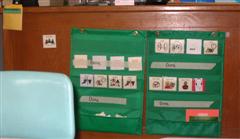
This is an example of a daily schedule that I have used with a student.
Routines
Routines are very important for these students! They help to build independence and flexibility.
For example, checking the schedule
Visual Cues<
/a>
Instead of using a lot of words, use pictures.
Examples:
- Visual instructions - a list.
- Visual organization - keeping all of the materials together in one spot.
- Visual clarity - color coding or highlighting.
- Visual Instructions - show instead of tell
With my student, I had pictures of him doing certain tasks. So, when it was time to put his crayon box away, for example, I would just show him a picture of him doing it as opposed to telling him. It was amazing because before this program I would tell him over and over and he just did not understand.
Social Stories
A social story is a written out story of a topic to give information to the student that they may not pick up on their own, especially regarding social information.
Here are some links to some of the social stories I have used:
Quiet Voice
Excuse Me
Sensory Needs
My student also had sensory needs. This can means that he was not processing some senses in the same way that others do.
Examples:
- Control of large motor function. A weighted vest helped my student to feel "grounded."
- My stundent had sensitive hearing and the normal noise of the classroom was often too much for him. Noise deafening headphones helped him to stay focused and to not be distracted.
- A chew necklace helps to calm when things get too overwhelming.
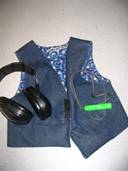
A weighted vest, chew necklace and noise deafening headphones.
Resources on the Webwww.autism-society.org
www.autism-resources.com
www.teach.com
www.dotolearn.com
www.medicine.uiowa.edu/autismservices
www.pecs.com
www.udel.edu/bkirby/asperger/
http://www.setbc.org/pictureset/default.aspx
< Back Next >
|
|
